RamsTrust meets Stuart Webb part 3 – Robert Maxwell

In our part 1 and 2 of our conversations with Stuart Webb, the former Derby County secretary, chief executive, director and chairman discussed the importance of ‘building a club, not a team’, his role in saving Derby from going out of business in 1984, and how his innovative ideas allowed the Rams to compete at the top of Division One in the 1970s. The focus of our interview this time is on a previous owner who craved publicity and loved being linked to the biggest names in the football world.
Born Ján Ludvík Hyman Binyamin Hoch in 1923 in then Czechoslovakia (now Ukraine), the former Army Captain and recipient of the Military Cross became a British subject in 1946 and later changed his name to Ian Robert Maxwell. Following Derby County’s victory in the High Court in 1984, the man frequently referred to as ‘Captain Bob’ in Stuart’s book Clough, Maxwell & Me invested in the Rams then became owner in 1987.
“Maxwell was a mega businessman on the world stage, I thought I had won the pools when I persuaded him to join Derby” says Stuart. “When Derby played Juventus (in the 1973 European Cup semi-final) I saw how Fiat, who are owned by the Agnelli family, helped to fund Juventus and wanted to do something like that at Derby. I saw how Derby County could be part of Maxwell’s empire and he saw that potential as well. He was looking for bigger and better projects all the time. He was drawn to the publicity and the crowd and was on the front and back pages of his newspapers every day and promoted himself very well. TV was starting to be a big platform and he was in the middle of that and could see the potential of his own empire expanding.”
Cox, Keegan…and Cruyff?
Just a few weeks after the club had been rescued from the brink of extinction – and nine years after winning their second Division One title – Derby were relegated to Division Three. Peter Taylor had resigned in April 1984 and was replaced by Arthur Cox who had been persuaded to resign from Newcastle United by Stuart.
“I thought Arthur Cox was the ideal man to get us up from the Third Division. He was a football man. We needed a change to go forward. He was having trouble at Newcastle and Kevin Keegan was going to be part of that package in a player/coach role. The connection between Arthur and Kevin was very strong. I took both of them to Japan at the end of one season on a promotional tour for the Keegan’s Kids TV programme. Arthur went along as a team member but Kevin was the attraction. He was coming to the end of his contract at Newcastle but felt there was more for him to do there. It was a punt from me at the time but it didn’t work out.”
Then Captain Bob called to say he was bringing in Jim Smith from Oxford United – the club that he already owned.
“I said: ‘Mr Maxwell, we have a manager’ and told him the situation and he slammed the phone down on me. I got hold of his son Ian, who was very professional in all matters, and he got his father to listen to me. I was really in trouble for 24 hours thinking I was going to have two managers in the same room at the press conference.”
This wasn’t the only time Maxwell interfered with football matters. Stuart recalls: “The Thursday prior to a Saturday game at the Baseball Ground, the chairman rings me up telling me that Johan Cruyff would be the head coach under Arthur Cox. The exclusive went into Maxwell’s newspaper the Daily Mirror and all hell broke loose. Cruyff was a famous name but I wasn’t for encouraging it as I knew it would cause problems and repercussions. We had Arthur Cox and Roy McFarland and were on the way up and I didn’t want to disrupt that. It was a publicity gimmick from the chairman and it put us on the world stage again but I don’t think it was ever seriously going to happen. The owner thought he would sell some more newspapers with a back page spread. He had met Cruyff and was photographed shaking hands with him at a function. I couldn’t see it working because I knew it was short-termism and he could have knocked us off our pathway to success.”
In the end – perhaps wisely – Johan Cruyff decided to join Spanish giants Barcelona as manager instead of moving to the East Midlands.
Complicated transfers
Robert Maxwell’s time at the Rams began well with back to back promotions from Division Three to Division One in 1985/1986 and 1986/1987, then a fifth place finish in the 1988/1989 season. This rise was funded by Captain Bob with England internationals Peter Shilton and Mark Wright joining for large fees, and Dean Saunders becoming Derby’s first £1 million player. However, not all the deals were straightforward to complete.
“Maxwell controlled the purse strings but when we tried to sign Mark Wright (from Southampton in 1987), I didn’t realise that he didn’t have the funds available” says Stuart. “Arthur and I put Mark up in a hotel in Derby for two or three days but Maxwell argued that he wasn’t fit and was doing anything to make it not happen. Mark was getting frustrated and we almost lost him. I went around the directors to ask for loans to get the deal through.”
In Clough, Maxwell & Me, Stuart wrote that he put in £20,000 himself and collected another £20,000 from each of the four other directors to make a down payment of £100,000 to Southampton so the transfer could be completed.
“I got a call from a journalist at The Mirror so I told him what was going on and he released it the next morning. Maxwell didn’t know about it and he was furious! I was fighting with one hand tied behind my back. The transfer fee was not spread over the contract like today. The Football League would allow you to put 50% down then spread the rest over two years which was the norm. Otherwise it was an agreement between the clubs and at that stage there were no sell on clauses as they were just coming into vogue.”
“With Dean Saunders, I knew it could be seen as a conflict of interest from one club to another (Maxwell owned Saunders’ club Oxford United as well as Derby County) so I made sure I got the Football League involved in all the paperwork. It looked like it could have been a difficult one but it wasn’t because we made it very clear. Other clubs were sniffing around to sign Dean from Oxford but we got priority because of the Maxwell connection.”
Maxwell’s attempt to sign the two Czech internationals Ivo Knoflicek and Lubos Kubik from Slavia Prague in 1988 is well-known amongst Rams fans. Stuart describes this as the most complex transfer that he was involved in. The players had walked out of a pre-season training camp in West Germany to seek asylum in the West and Robert Maxwell wanted to sign them both on free transfers. The whole episode went on for months.
“I couldn’t see it ever happening but it caused chaos in diplomatic circles and I went to all sorts of embassies. It was quite difficult at times to keep the day job going as well as this. The whole thing was an international incident caused by Robert Maxwell wanting them to jump ship. They had absconded from the training camp, which was unusual, and they tried to get diplomatic immunity. Maxwell had promised them the Earth. The Czech government had tried to get them back and there were some mysterious guys at the hotel (where Stuart and Arthur Cox had gone to meet the players in Brussels under orders from Maxwell). We could see there were issues and people around who were not pleasant. So when myself and Arthur went to bed that night in the hotel we put a cupboard behind the door!” Knoflicek and Kubik were moved near Barcelona before eventually arriving in Derby and were introduced to supporters on the Baseball Ground pitch before the FA Cup game against Southampton on 7 January 1989. A week later, the official programme from the West Ham game informed supporters that the players had received work permits to enter the UK and were only awaiting FIFA clearance before they could play for the Rams.
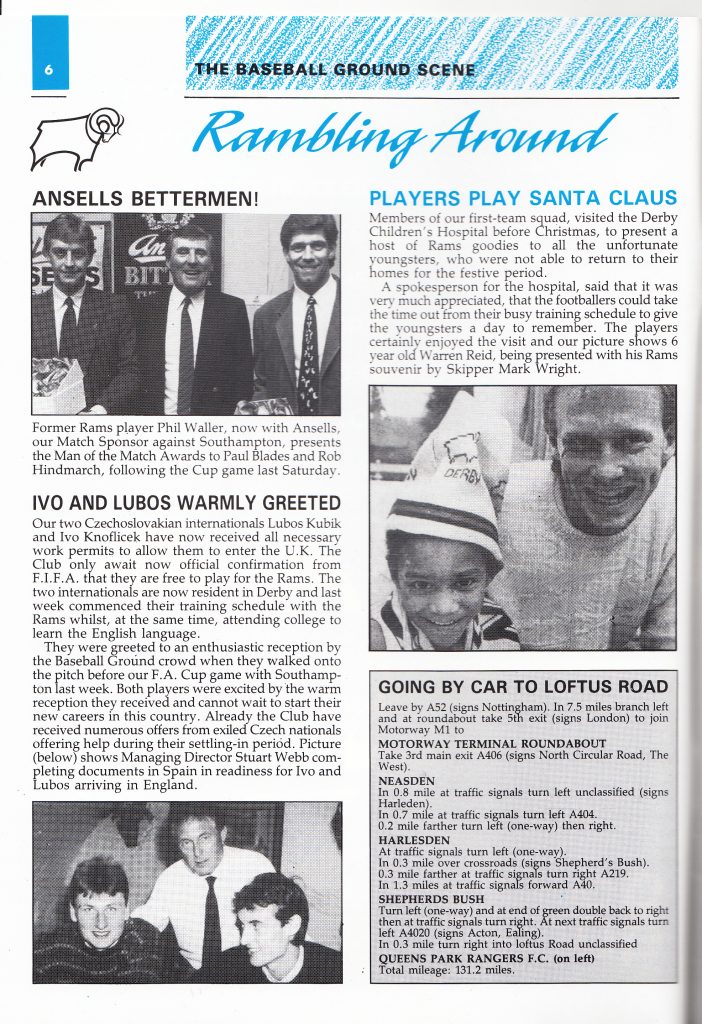
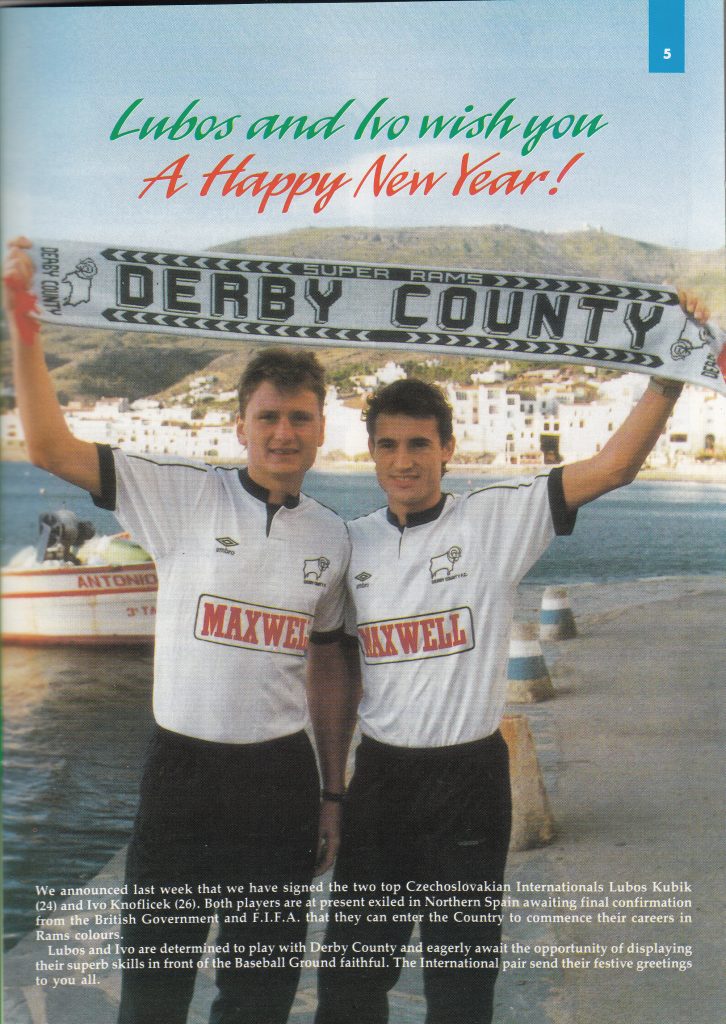
“I advised Maxwell it was never going to happen. We had the agreement of the players but not the agreement of the FA of both countries and their club unless we paid £300,000-£400,000 which we were not going to do. It’s a bit like when Ian Storey-Moore was paraded on the Baseball Ground pitch (in 1972). We only had two signatures (Derby County’s and the player’s) but we didn’t have Forest’s so we were never going to have a transfer. The whole of football was thinking ‘what the hell are you doing’?”
“We went to MPs, cabinet ministers, everyone you can think of but no-one could get the club (Slavia Prague) to agree to a signature. We couldn’t have played them anyway. Maxwell thought there was a way forward but there wasn’t unless their club agreed on a free transfer. There were too many hurdles. He had all the publicity and ran it through his newspaper and thought he could bulldoze the deal through.”
Fall
After finishing fifth in Division One in 1988/1989, Derby supporters naturally expected the good times to continue and for the team to push on and maintain their place towards the top of the league. In order for this to happen, further investment from Robert Maxwell would be required. This did not materialise and Derby finished the 1989/1990 season in 16th place having sold Paul Goddard to Millwall for a club record fee of £800,000 mid-way through the campaign, a sign that Maxwell was starting to balance the books.
The 1990/1991 season would be even worse as Maxwell regularly criticised the low attendances at the Baseball Ground and reminded supporters that gates had to be over 20,000 for him to continue investing in the team.
Stuart recalls: “Maxwell was interested in the idea of being the man of the people. But he fell out of love with football and the Rams, I could see it drying up and it was tougher for us to justify signing a new player. Maxwell would always have spoken to a journalist and was putting obstacles in the way of transfers and saying players were injury prone. Excuses were being put forward and I sensed we were coming to the end of the relationship. He realised we had to spend to get to where we wanted but it was becoming harder to convince him; we needed a good cup run to generate extra funds and do it ourselves rather than go to him.”
Stuart describes in Clough, Maxwell and Me how Derby fans turned against Maxwell during the 7-1 home defeat by Liverpool on 23 March 1991. At this point, Derby had not won a league game since 1 December. Arsenal were next to visit the Baseball Ground on 30 March, one of the handful of home games Maxwell attended during his time as owner.
“Maxwell told me his introduction to football was when he was a young boy in Czechoslovakia, Arsenal played a team in a local town” says Stuart. “He said he got through a turnstile as boys do to watch this great team play and seeing at first hand these giants in red created a lasting memory.”
Although Maxwell was likely to have been delighted to attend the fixture in the Directors’ Box, the Rams suffered yet another defeat, this time 2-0, with the chairman being on the receiving end of the Derby fans’ vitriol. Maxwell initially thought that supporters were singing his name in praise. But at half time, the Arsenal vice-chairman asked Stuart why the Derby supporters didn’t like the owner. Maxwell overheard the conversation then realised what the fans were singing in the second half before storming out of the ground. This event is described in some detail in Stuart’s book.
Maxwell put Derby County up for sale for £8 million with the club £2 million in debt. However, interest from prospective buyers was limited with only Lionel Pickering, owner of the Derby Trader newspaper, making serious enquiries.
“Neil Hallam (a journalist at the Derby Trader) was constantly attacking the club in the paper, which Maxwell saw as undermining the club, the players and the value of the club when it was up for sale, so he banned Pickering from the Baseball Ground. Eventually though Maxwell must have realised enough was enough because no-one else was interested in buying Derby at that time so he finally agreed to sell to Lionel.”
A few months later, on 4 November 1991, Robert Maxwell was dead. The official cause of death was listed as a heart attack after Maxwell fell off his yacht near the Canary Islands.
How does Stuart view Maxwell’s time at Derby overall?
“The Maxwell chapter was a successful period both on and off the field and we started a great period in the club’s history. We won two back to back promotions and stabilised the club financially. When Maxwell sold the club and washed his hands of football, he could not understand why the Derby fans turned on him when under his ownership the club had been successful with two promotions as well as signing some outstanding international players.”
We have signed copies of Clough, Maxwell and Me for sale which have kindly been donated by Stuart to raise funds for RamsTrust. These are priced at £25 each plus £3.85 delivery (UK only). Further information on how to order a signed copy of the book can be found here.